
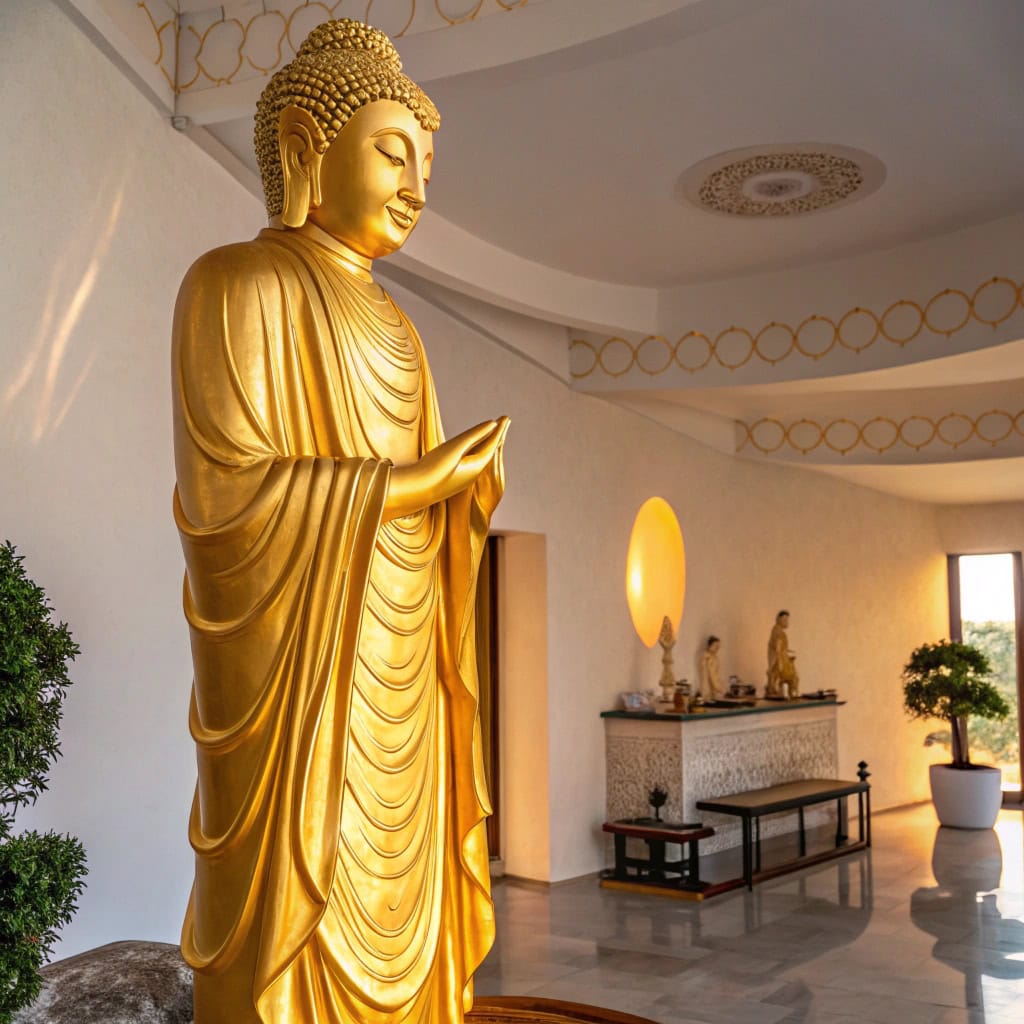
This is the foundation of mindfulness practice and the Noble Eightfold Path — but you don’t need to be a monk to use it.
Anapanasati — means “mindful breathing”. It’s what the Buddha taught in the Ānāpānasati Sutta (MN 118). It’s not about emptying your mind — it’s about noticing what’s already there.
Among all practices, one stands out — not because it’s hard, but because it’s simple and powerful: Anapanasati — paying attention to your breath.
In the “Ānāpānasati Sutta” (MN 118), the Buddha says: this practice brings great benefit. Why? Because when you watch your breath, you stop fighting your thoughts — you just let them be.
There’s no “I am breathing”. There’s just breath — rising, falling, cool, warm. And in that simplicity, you start to see: thoughts are not you. Emotions are not you. Stress is not you. You’re the one who notices them.
That’s why Anapanasati helps with anxiety, distraction, and overwhelm. Not by changing your thoughts — but by changing your relationship to them.
Anapanasati and the Four Real Truths
Anapanasati isn’t just “sitting quietly”. It’s the practical way to understand the Four Real Truths (read more here):
- See stress (dukkha): When you notice your breath, you see — it changes. You can’t control it. That’s the first truth: life is unpredictable.
- Let go of craving (taṇhā): When you stop trying to “fix” your breath or make it “perfect”, craving fades. That’s the second truth: suffering comes from wanting things to be different.
- Experience peace (nirodha): In the moment you’re just watching your breath — stress stops. That’s the third truth: peace is possible, right now.
- Follow the path (magga): This practice is part of the Noble Eightfold Path — especially “right mindfulness” and “right concentration”.
16 Steps — Don’t Memorize Them, Just Live Them
The Buddha described 16 steps — grouped into 4 sets:
- Body: Notice if your breath is long or short. Feel it in your nose, chest, or belly.
- Feelings: Notice if you feel calm, restless, happy, or bored — without judging.
- Mind: Notice if your mind is focused, distracted, or peaceful — just observe.
- Insights: See that everything changes (anicca), nothing lasts (dukkha), and there’s no fixed “you” (anattā).
You don’t need to do all 16 at once. Start with step 1 — just noticing your breath. That’s enough.
Why This Works Against Overthinking
When you think “I’m stressed”, your brain creates a story: “I’m failing”, “I can’t handle this”, “I’m alone”. But if, in that moment, you just return to your breath — without fighting the thought — the story loses its power.
Stress becomes just a sensation. Worry becomes just a thought. And you? You’re still here — watching.
How to Start — No Special Gear Needed
- Sit comfortably. On a chair, on your bed, even on the floor.
- Notice your natural breath — no need to change it.
- Just know: “in-breath”, “out-breath”. That’s it.
- When your mind wanders (and it will!) — gently bring it back. No scolding yourself.
- Try 5–10 minutes a day. Even 1 minute counts.
This isn’t about becoming perfect. It’s about being present — here and now.
How This Fits Into the Noble Eightfold Path
Anapanasati is the heart of “right mindfulness” (sati) and “right concentration” (samādhi) — the last two parts of the Noble Eightfold Path. Without it, the path is just theory. With it — it’s something you live every day.
Also read:
Key Pāli terms (for reference):
ānāpānasati, sati, samādhi, anicca, dukkha, anattā, taṇhā, avijjā, kamma
Sources
– “Ānāpānasati Sutta“, Majjhima Nikāya 118, Pali Text Society (PTS).
– Russian translation: “Majjhima Nikāya”, Ganga Publishing House, Moscow, 2022.
– Pāli terms: ānāpānasati, sati, samādhi, anicca, dukkha, anattā, taṇhā, avijjā, kamma.