

Authoritative translations from the Pali Text Society — primary source for Theravada Buddhist terminology
Authoritative translations from the Pali Text Society — primary source for Theravada Buddhist terminology
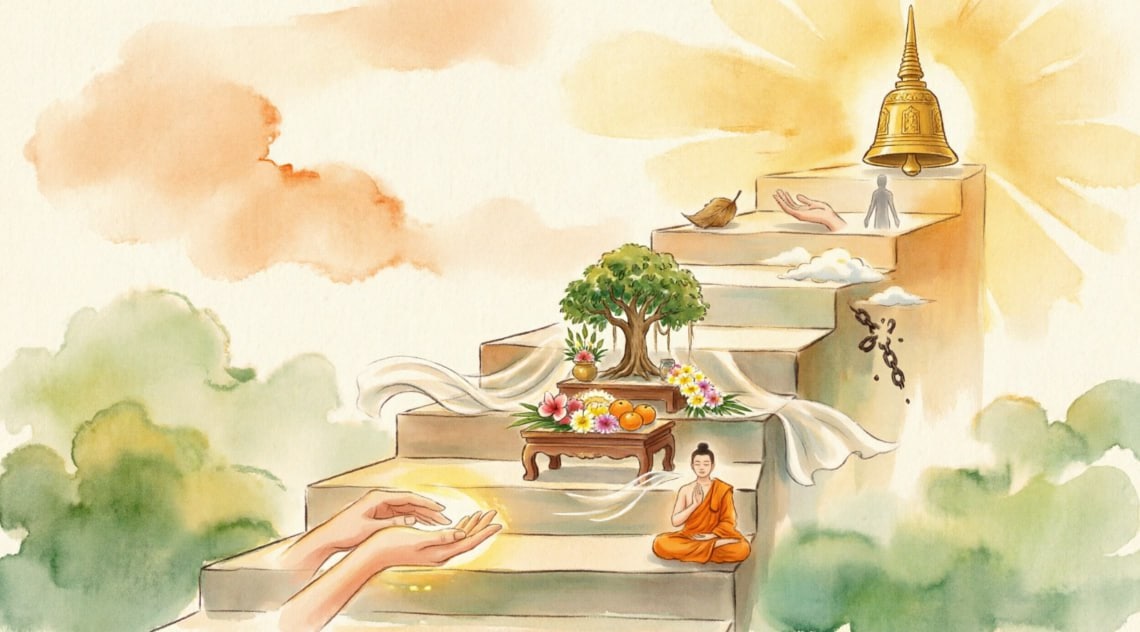
First of all, visuddhi (Pali: visuddhi) simply means ‘purification’ or ‘cleaning’. In the Theravada tradition, it is a practical way to make your mind clearer and calmer. For this reason, in the MN 24 Rathavinīta Sutta (The Discourse on Relay Chariots), the Buddha explains seven simple steps that help us move from stress to peace.
In other words, visuddhi is not about being perfect. It is about taking small, steady steps — like cleaning a dusty window, one wipe at a time, until you can see clearly.
First of all, let us look at each step in a way that makes sense for your life:
First and foremost, start with your actions. Sīla means living kindly and honestly. Thanks to this, your mind feels lighter because you have less to worry about.
Teen example: Telling the truth, being kind to friends, not taking what is not yours — these small choices build a calm mind.
Beyond good actions, it helps to calm your thoughts. The Buddha taught that five things often distract us: wanting, anger, sleepiness, restlessness, and doubt (nīvaraṇa). Thus, practices like mindfulness of breathing (ānāpānasati) help your mind settle.
Teen example: When you feel stressed before a test, take three slow breaths. Notice how your mind becomes a little quieter.
Moreover, it is important to see things as they really are. The Buddha taught that there is no fixed ‘me’ — just changing thoughts, feelings, and experiences (khandha). In other words, this is understanding anattā (not-self).
Teen example: When you feel ‘I am bad at this’, remember: this is just a thought, not the whole truth. Thoughts come and go.
At this stage, you learn to let go of worries about the past or future. For this reason, you see how things happen because of conditions (paṭiccasamuppāda).
Teen example: Instead of worrying ‘What if I fail?’, ask ‘What can I do right now?’ This simple shift reduces stress.
Through practice, you learn to tell the difference: what truly helps your mind grow, and what only feels good for a moment. Thus, you do not mistake temporary comfort for real peace.
Teen example: Scrolling social media might feel relaxing, but does it leave your mind clearer? Sometimes a short walk helps more.
At this stage, you directly see three truths: anicca (things change), dukkha (stress happens), and anattā (no fixed self). As a result, your mind naturally lets go of clinging.
Teen example: When a friendship changes, instead of fighting it, you notice: ‘This is how life is.’ This brings peace, not sadness.
Finally, the last step is complete understanding and freedom. Thanks to this, you experience nibbāna — the end of suffering.
Teen example: This is not about becoming a different person. It is about being fully yourself, without the weight of worry or fear.
💡 Quick Tip: You do not need to do all seven steps at once. Start with one: be kind today, or take three mindful breaths. Small steps lead far.
Beyond MN 24, the Buddha spoke about purification in other talks too:
Thus, visuddhi is not a theory. It is a practical path, spoken by the Buddha himself, for anyone who wants a calmer mind.
First and foremost, remember: this path is for everyone — teens, students, young adults. For this reason:
Thanks to this approach, you build a strong foundation for peace — whether you are at school, at home, or with friends.
It is very important to understand that visuddhi is, first and foremost, a path from a busy mind to a clear mind, from stress to freedom. For this reason, the seven steps from MN 24 remain a simple, practical guide for anyone in the Theravada tradition.
Therefore, do not wait for the ‘perfect time’. Start small. Even one mindful breath brings you closer to peace.
Furthermore, if you wish to learn more about the Buddha’s teachings, we recommend:
Beyond MN 24, the concept of visuddhi is also revealed in other suttas:
Furthermore, you can find these suttas on Access to Insight or SuttaCentral.
«Do it right the first time. If you make a mistake — fix it straight away.»