
Four Foundations of Mindfulness
The Buddha’s practical method for building awareness in everyday life — no special equipment needed, just your attention
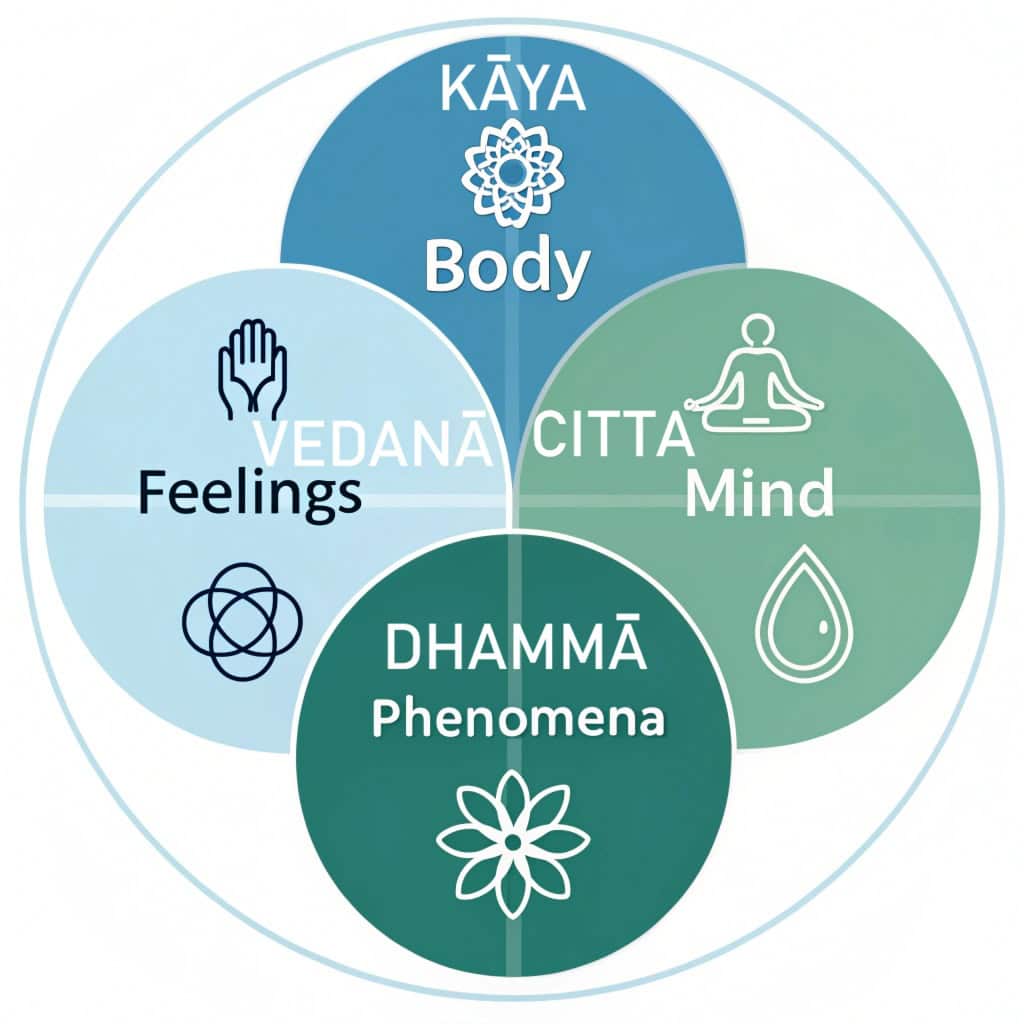
When the Buddha taught meditation, he didn’t give abstract theories — he offered four concrete places to put your attention. These Four Foundations of Mindfulness (satipaṭṭhāna) are the backbone of all mindfulness practice in Buddhism, described in the famous Satipaṭṭhāna Sutta (MN 10).
The Buddha said this is: “the one way to purify beings, overcome sorrow and lamentation, end pain and grief, reach the right path, and realize nibbāna“.
The Four Foundations
These four foundations are:
- Body (kāya) — awareness of physical sensations
- Feelings (vedanā) — awareness of pleasant, unpleasant, and neutral experiences
- Mind (citta) — awareness of mental states (craving, anger, calm)
- Dhammas (dhammā) — awareness of patterns and laws of nature
The first foundation starts with the most obvious thing: your body. The Buddha began his instructions with something as simple as:
“When breathing in long, he knows: ‘I breathe in long.’ When breathing out long, he knows: ‘I breathe out long.’” (MN 118)
This includes ānāpānasati (mindful breathing), awareness of postures and movements, and reflections on the impermanent nature of the body.
The second foundation helps you understand how you react to life’s experiences. We notice:
The third foundation is about observing your mental states directly:
“When the mind is agitated, he knows: ‘My mind is agitated.’ When the mind is calm, he knows: ‘My mind is calm.’”
This means noticing whether your mind contains greed, aversion, delusion, concentration, joy, etc.
The fourth foundation is about observing the patterns and laws of nature:
- Five hindrances — sensual desire, ill will, dullness, restlessness, doubt
- Seven factors of enlightenment
- Four Noble Truths
How to Practice
You don’t need special conditions to practice the Four Foundations of Mindfulness. They work anywhere, anytime:
- At school: Notice your posture, feelings about subjects, mental states during tests
- In relationships: Observe physical reactions, emotional responses, mental judgments
- On social media: Notice body sensations, emotional rollercoaster, craving for validation
What the Buddha Said
“This is the one way, monks, for the purification of beings, for the overcoming of sorrow and lamentation, for the disappearance of pain and grief, for reaching the right path, for the realization of nibbāna — that is to say, the four foundations of mindfulness.” (MN 10)
Continue Your Journey
Related practices:
Mindful Breathing Practice |
Seven Factors of Enlightenment |
Five Spiritual Faculties |
Noble Eightfold Path
Sources
– MN 10 — Mahāsatipaṭṭhāna Sutta
– MN 118 — Ānāpānasati Sutta
Translations verified against the Pali Text Society (PTS) edition.
Author: Rā • Updated: 05 March 2026